

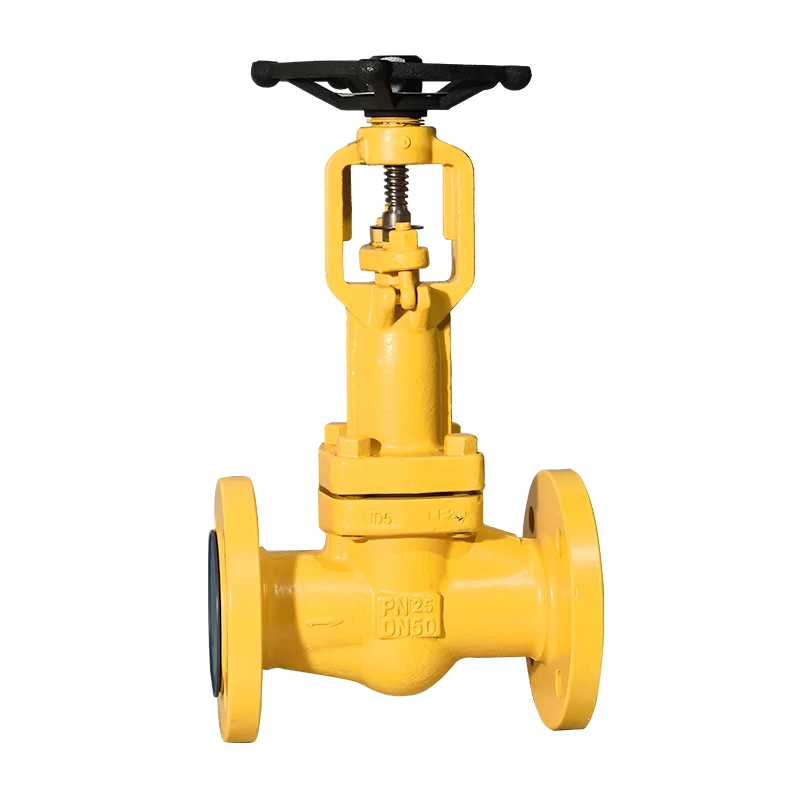
The Pressure Seal Angle Globe Valve combines high-pressure self-sealing bonnet technology with a 90-degree body layout for throttling and isolation in thermal steam and high-pressure liquid lines. Design ratings reach ASME Class 2500. System internal fluid pressure energizes the metallic sealing ring to maintain joint tightness under severe thermal cycles. The angled flow path eliminates extra pipe elbows and minimizes layout resistance.
Key Features
Self-Energized Pressure Seal: Internal system pressure applies direct force on the metallic sealing gasket, increasing joint tightness as operating pressure rises.
Integral 90-Degree Flow Axis: Directs high-velocity fluid through a right-angle body geometry, eliminating extra pipe bends, weld seams, and pressure drop.
Fully Guided Disc Assembly: Guided plug disc combined with Stellite hardfaced seats prevents stem oscillation, disk chatter, and wear during high-differential-pressure throttling.
Low-Torque Stem Drive: Precision ACME stem threading and anti-friction thrust bearings reduce operational handwheel seating torque and packing stress.
Live-Loaded Packing Seal: Belleville spring sets provide constant axial load on die-molded graphite rings to maintain fugitive emission control under thermal transients.
Hardfaced Seating Surfaces: Cobalt-base alloy overlays on body seats and disc faces deliver resistance to cavitation erosion, wire-drawing, and thermal fatigue.
Design & Construction
Body Configuration: Forged or heavy-wall cast angle pattern body matching ASME B16.34 dimensions with optimized wall thickness at pressure boundaries.
Bonnet Assembly: Pressure seal structure incorporating segmented thrust rings, spacer rings, and graphite-coated silver-plated metal seal gaskets.
Stem & Yoke Interface: Precision-ground stem with a surface finish rating of Ra 0.4 microns or smoother, fitted through a two-piece self-aligning gland flange mounted on a heavy-duty yoke structure.
Disc Design Options: Parabolic plug disc for linear regulation, needle disc for low-flow calibration, or flat-faced disc for tight isolation service.
Working Principle
Rotation of the handwheel or drive actuator transmits linear down-thrust to the stem and disc, driving the hardfaced sealing face firmly against the integral body seat to shut off flow. Fluid enters the lower body port, travels upward across the orifice, redirects at a 90-degree angle through the main chamber, and exits via the horizontal outlet. Internal pressure acts on the lower face of the bonnet assembly, forcing the wedge-shaped pressure seal gasket upward against the body bore taper to reinforce the pressure boundary seal automatically during normal operation.
Technical Specifications
|
Parameter |
Specification & Engineering Limits |
|
Nominal Diameter |
DN15 to DN400 / 1/2 inch to 16 inch |
|
Pressure Rating |
ASME Class 900, Class 1500, Class 2500 / PN160 to PN420 |
|
Operating Temperature |
-29°C to +600°C (-20°F to +1112°F) based on shell alloy selection |
|
Design Standard |
ASME B16.34, BS 1873, EN 12516 |
|
Face-to-Face Standard |
ASME B16.10, EN 558 Series 1 / Series 8 |
|
End Connection Style |
Butt-Weld (BW to ASME B16.25), Ring Type Joint (RTJ to ASME B16.5), Raised Face (RF) |
|
Shut-Off Leakage Rate |
ANSI/FCI 70-2 Class IV / Class V, ISO 5208 Rate A, API 598 |
|
Fugitive Emissions |
API 624 certified, ISO 15848-1 Class AH / BH compliant |
Materials & Trim
|
Component |
Carbon Steel Service |
High-Temp Alloy Steel |
Stainless Steel Service |
Super Alloy Service |
|
Body & Bonnet |
ASTM A105 / A216 WCB |
ASTM A182 F22 / A217 WC9 / F91 |
ASTM A182 F316 / A351 CF8M |
ASTM A182 F51 / Inconel 625 |
|
Disc Seating |
A105 + Stellite #6 |
A182 F22 + Stellite #6 |
A182 F316 + Stellite #6 |
Inconel 625 + Stellite #6 |
|
Body Seat Ring |
A105 + Stellite #6 |
A182 F22 + Stellite #6 |
A182 F316 + Stellite #6 |
Integral Stellite Overlay |
|
Valve Stem |
ASTM A182 F6a Class 2 |
ASTM A182 F6a / F22 |
ASTM A182 F316 |
17-4PH / Inconel 718 |
|
Pressure Seal Ring |
Soft Steel + Silver Plated |
Alloy Steel + Silver Plated |
Stainless 316 + Graphite |
Inconel 718 + Silver Coat |
|
Gland Packing |
Die-molded Flexible Graphite with braided carbon anti-extrusion end rings |
|||
Connection & Configuration
Butt-Weld (BW): Prepared bevel end configurations per ASME B16.25 matching Schedules 80, 160, and XXS piping to eliminate external joint leaks in high-temperature lines.
Ring Type Joint (RTJ): Precision-machined metallic ring grooves per ASME B16.5 for high-pressure flanged system connections.
Raised Face (RF): Standard smooth or spiral serrated gasket face finish with Ra 3.2 to 6.3 microns for removable piping runs.
Orientation: 90-degree right-angle body geometry with vertical or side-slanted stem mounting options.
Actuation Options
Manual Drive: Fully enclosed gearboxes with tapered roller thrust bearings and position indicators.
Electric Actuation: Multi-turn electric drives featuring torque limit switches, integrated controllers, and ISO 5210 top mounting flanges.
Pneumatic Actuation: Spring-return or double-acting piston actuators paired with electro-pneumatic positioners using 4 to 20 milliamp signals.
Hydraulic Control: High-pressure hydraulic cylinder interface setups for rapid-response safety isolation.
Standards & Testing Compliance
Manufacturing Criteria: Conforms strictly to ASME B16.34, BS 1873, and EN 12516 design rules.
Pressure Testing: Hydrostatic shell proof testing at 1.5 times cold working pressure; high-pressure liquid and low-pressure gas seat leakage testing per API 598 and ISO 5208.
Fugitive Emissions Testing: Stem packing seals certified to API 624 and ISO 15848-1 helium endurance testing.
Non-Destructive Testing: Radiographic testing on pressure-containing castings, Ultrasonic testing on raw forgings, and Liquid Penetrant or Magnetic Particle inspection on seating overlays and weld end bevels.
Fire Safety: Design verified to API 607 and ISO 10497 standards.
Industry Applications
Boiler Feedwater Isolation: Controls high-pressure feedwater supply and isolation before entering economizer units.
Main Steam Line Drains: Handles high-temperature steam venting without experiencing body wall cavitation or seat degradation.
Petrochemical Hydrocracking: Manages high-pressure, hydrogen-rich chemical media under elevated line pressure.
Supercritical Steam Isolation: Installed in power plant steam manifolds to modulate line pressure parameters.
High-Pressure Blowdown Loops: Resists fluid erosion and seat flashing during periodic boiler blowdown operations.
Technical Selection Guide
Identify Flow Parameters: Determine maximum operating pressure, working temperature, fluid state, and required flow coefficient.
Select Body Metallurgy: Select material grades based on medium temperatures: Carbon Steel up to 425°C, Low Alloy Steel (WC6 or WC9) up to 550°C, or High Alloy Steel (F91 or C12A) for temperatures up to 600°C and higher.
Determine Pressure Class: Match system pressure and temperature against ASME B16.34 pressure-temperature rating charts to confirm Class 900, 1500, or 2500 suitability.
Select Connection Ends: Choose butt-weld ends for permanent high-pressure piping manifolds, or RTJ flanged joints where periodic line removal is required.
Verify Trim Hardfacing: Ensure full Cobalt-base hardfacing (Stellite #6) on both seat and disc surfaces when pressure drops exceed 50 bar.
Configure Actuation: Calculate maximum operating torque under differential shut-off conditions and match with handwheel gearbox or electric or pneumatic drive setups per ISO 5210.
Inspection & Documentation
Material Traceability: EN 10204 Type 3.1 inspection certificates covering chemical composition, mechanical properties, impact testing, and heat treatment logs.
Non-Destructive Inspection Qualification Records: Certified test reports covering Radiographic, Ultrasonic, Magnetic Particle, and Liquid Penetrant procedures executed according to ASME Section V.
Pressure Hydro-Test Charts: Pressure-time chart recordings covering shell, backseat, and high-pressure closure tests compliant with API 598.
Dimensional Inspection Logs: Coordinate measuring machine dimensional verification, wall thickness measurements, and stem roughness test results.
Regulatory Compliance: CE and PED 2014/68/EU certificates, EAC conformity documents, and API 624 fugitive emissions test certificates.
Engineering Customization
Custom Face-to-Center Dimensions: Tailored body dimensions manufactured to meet precise drop-in replacement requirements for existing piping runs.
Extended Stem Assemblies: Extended bonnets engineered for cryogenically insulated or high-temperature insulated piping runs.
Multi-Stage Anti-Cavitation Trim: Perforated cage discs engineered to break up pressure drops and eliminate cavitation in severe water lines.
Special Alloy Options: Corrosion-resistant fabrications available in Monel, Inconel, Duplex, or Hastelloy.
Project Nameplate Tagging: Stainless steel tags stamped with project tag numbers, pipeline identification numbers, and customer part designations.
Frequently Asked Questions
Q: What is the core structural benefit of an angle pattern globe valve over a straight-way globe valve?
A: The angle pattern configuration changes fluid flow direction by 90 degrees within the valve body itself. This allows the valve to serve as both an isolation unit and a 90-degree pipe elbow, eliminating pipe fittings, reducing total line pressure drop, and minimizing total space in high-pressure steam systems.
Q: How does a pressure seal bonnet maintain seal integrity under high temperature cycles?
A: Unlike bolted bonnets that rely on stud bolt tension, a pressure seal bonnet uses internal line pressure to force an internal metallic wedge gasket tightly against the tapered body bore. As fluid pressure rises, the sealing force increases proportionally, securing a tight joint during severe thermal and pressure fluctuations.
Q: Which body material is recommended for steam applications operating above 540°C?
A: For steam environments ranging between 540°C and 600°C, alloy steels such as ASTM A182 F22 (2.25Cr-1Mo) or high-grade ASTM A182 F91 or A217 C12A (9Cr-1Mo-V) are required. These chrome-moly alloys provide superior creep-rupture strength, thermal stability, and oxidation resistance.
Q: Is this valve engineered for continuous high-differential-pressure throttling?
A: Yes. The disc assembly features fully guided alignment along with Stellite #6 cobalt-hardfaced seating faces to prevent disk chatter, stem vibration, and wire-drawing erosion. For extreme differential pressure drops that induce severe fluid flashing or noise, customized multi-stage anti-cavitation trim options are available.
Q: What non-destructive examination methods are applied to welded connections?
A: Butt-weld ends undergo Magnetic Particle or Liquid Penetrant Inspection on machined bevel surfaces, alongside 100% Radiographic Testing or Ultrasonic Testing across the pressure-retaining body walls per ASME B16.34 requirements.
Hot Tags: pressure seal angle globe valve, China pressure seal angle globe valve manufacturers, suppliers, factory, API Pressure Sealing Globe Valve, cast globe valve, cryogenic control globe valve, GB Standard Globe Valve, soft seated globe valve, vent globe valve


