

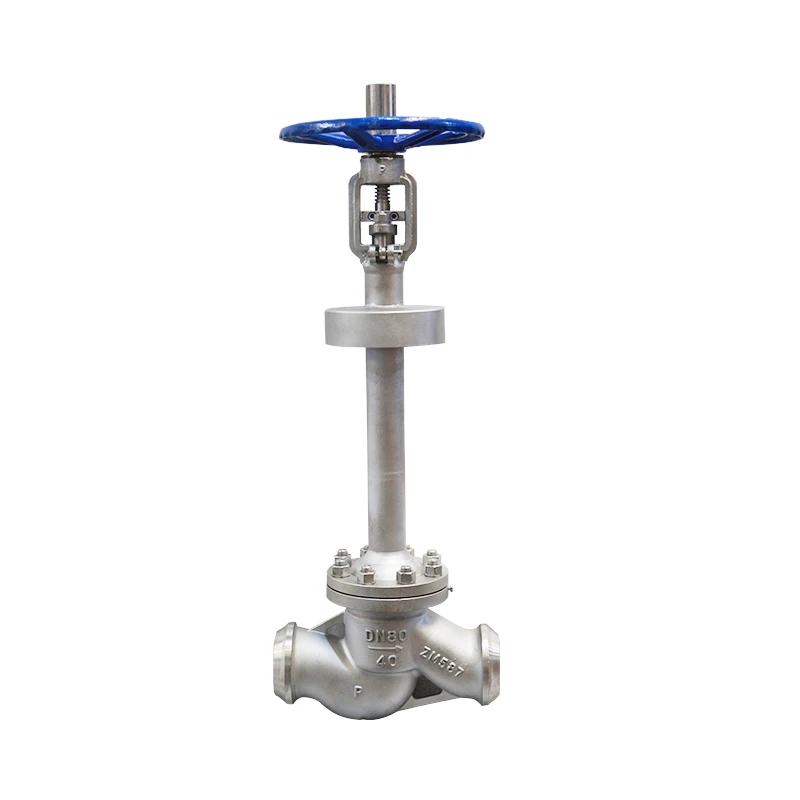
Butt Weld Pressure Seal Globe Valves integrate internal system pressure to secure body-bonnet sealing under extreme temperature and pressure conditions. Designed for rigid piping systems in severe services, these valves feature full-penetration welded ends that eliminate potential mechanical joint leak paths.
Key Features
Pressure-Assisted Bonnet Joint: Internal fluid pressure drives the flexible graphite or metallic seal ring tighter against the body inside diameter, increasing seal integrity as system pressure rises.
Hermetic Weld Connections: Butt weld end preparation per ASME B16.25 forms a continuous, permanent pipe-to-valve connection resistant to thermal cycling and line stress.
Hardfaced Seating Interface: Cobalt-base Stellite No. 6 hardfacing applied via Plasma Transferred Arc (PTA) welding on both seat and disc surfaces prevents erosion, galling, and wire-drawing under high differential pressures.
Guided Disc Mechanism: Fully guided stem and disc assembly maintains coaxial alignment throughout the stroke length, minimizing vibration and seat deformation during throttling.
Non-Rotating Stem Design: Acme-threaded stem combined with heavy-duty needle thrust bearings lowers operating torque and protects stem packing from rotational wear.
Design & Construction
Body Architecture: Cast or forged heavy-wall pressure boundary engineered to absorb structural piping loads, hydraulic shock, and sudden temperature shifts.
Bonnet Retaining Assembly: Includes bonnet thrust ring, segmented key rings, and a precision-machined pressure seal gasket positioned inside the body chamber.
Gland Packing Structure: Two-piece self-aligning gland flange prevents stem binding caused by angular misalignment or thermal expansion.
Integral Backseat: Precision-machined backseat allows stem packing isolation in the fully open position.
Working Principle
Flow control relies on linear stem displacement driving the disc perpendicular to the body seat. Turning the handwheel or operating the actuator advances the stem, pressing the Stellite-faced disc against the body seat for positive shutoff or positioning it off the seat for flow regulation. System pressure acting against the lower side of the bonnet forces the pressure seal ring upward against the body wall, forming a pressure-tight barrier.
Technical Specifications
|
Parameter |
Standard Specification |
Extended / Custom Option |
|
Nominal Diameter |
NPS 2" – 24" (DN 50 – 600) |
Up to NPS 36" (DN 900) |
|
Pressure Rating |
ASME Class 900, 1500, 2500 |
ASME Class 4500 / PN 160 – PN 720 |
|
Operating Temperature |
-29°C to 593°C |
Up to 650°C with modified alloy trim |
|
End Connection |
Butt Weld (ASME B16.25) |
Custom pipe schedule wall thickness |
|
Design Standard |
API 623, ASME B16.34, BS 1873 |
ISO 15761, EN 12516 |
|
Face-to-Face |
ASME B16.10 |
Manufacturer standard for pressure seal |
|
Pressure Testing |
API 598, ISO 5208 |
MSS SP-61 |
|
Fugitive Emission |
ISO 15848-1 Class AH, API 641 |
Custom live-loaded packing assemblies |
Materials & Trim
|
Component |
Carbon Steel Trim |
Alloy Steel Trim |
Stainless Steel Trim |
|
Body / Bonnet |
ASTM A216 WCB / A105 |
ASTM A217 WC9 / C12A / A182 F22 / F91 |
ASTM A351 CF8M / A182 F316 |
|
Disc Seating Face |
Stellite No. 6 Overlay (Min. 2mm thickness, HRC 38-42) |
Stellite No. 6 Overlay (Min. 2mm thickness, HRC 38-42) |
Stellite No. 6 Overlay (Min. 2mm thickness, HRC 38-42) |
|
Body Seat Ring |
Integral / Stellite No. 6 Overlay |
Integral / Stellite No. 6 Overlay |
Integral / Stellite No. 6 Overlay |
|
Stem |
ASTM A276 410 / 17-4PH |
ASTM A276 410 / 17-4PH |
ASTM A276 316 / 316H |
|
Stem Packing |
Die-formed Flexible Graphite Rings |
Flexible Graphite with Braided Carbon End Rings |
Flexible Graphite with Zinc Corrosion Inhibitor |
|
Pressure Seal Ring |
Silver-plated Soft Steel |
Silver-plated Stainless Steel 316 |
Inconel 718 / Stainless Steel 316 |
Connection & Configuration
End Welding Profiles: Standard bevel profiles per ASME B16.25 to match Schedule 80, Schedule 160, XXS, or specified pipe wall dimensions.
Body Flow Profiles:
Straight-Through T-Pattern for compact installation footprints.
Y-Pattern angled body structure reducing internal turbulence and pressure drop by up to 40 percent.
90-Degree Angle Pattern serving as an elbow replacement in high-pressure header lines.
Actuation
Manual Control: Heavy-duty handwheel with impactor mechanism or spur/bevel gearboxes for high differential pressure operation.
Electric Actuation: Multi-turn electric actuators equipped with torque switches, position transmitters, and field network interface units.
Pneumatic Actuation: Linear spring-return or double-acting pneumatic piston actuators with digital valve positioners and air filter regulators.
Hydraulic Actuation: High-thrust electro-hydraulic actuators for fast emergency shutdown or precise modulating control.
Standards & Testing
Design Compliance: ASME B16.34, API 623, BS 1873.
Pressure Testing: Hydrostatic shell test at 1.5 times nominal pressure and high-pressure seat closure test per API 598.
Non-Destructive Examination (NDE):
• 100 Percent Radiographic Testing (RT) or Ultrasonic Testing (UT) on pressure-retaining castings and forgings.
• Dye Penetrant Testing (PT) or Magnetic Particle Testing (MT) on butt weld bevel preparations and Stellite overlay surfaces.
• Quality Certifications: Material Test Reports per EN 10204 3.1, CE/PED 2014/68/EU, ISO 9001, SIL 2/3 Safety Integrity Certification.
Applications
Fossil Power Generation: Main steam lines, boiler feed water regulation, hot reheat isolation, and turbine bypass control.
Nuclear Power Facilities: Secondary circuit main steam isolation and high-pressure water treatment piping.
Refining & Hydroprocessing: Hydrocracker units, catalytic reformers, high-pressure hydrogen feed systems, and gasification plants.
Chemical Processing: High-temperature synthesis gas loops and thermal fluid lines under extreme thermal shocks.
Selection Guide
Identify Operating Parameters: Define maximum operating temperature, design pressure, fluid chemical characteristics, and required flow coefficient (Cv).
Select Body Material:
Carbon Steel (WCB/A105) for non-corrosive steam and water service under 425°C.
Chrome-Moly Alloy Steel (WC9, F22, F91) for high-temperature steam applications up to 600°C requiring creep resistance.
Stainless Steel (CF8M/F316) for corrosive fluids or low-temperature media.
Specify Pipe Connection Profile: Match the valve weld bevel inside diameter and wall thickness directly to the matching pipe schedule to ensure penetration depth during field welding.
Choose Body Configuration: Select T-pattern for inline space constraints or Y-pattern to lower system head loss.
Calculate Operating Torque: Evaluate differential shutoff pressure to select manual gear operators or automated actuators.
Inspection & Documentation
Material Test Reports (MTR) according to EN 10204 3.1 verifying heat chemical composition and mechanical properties.
NDE examination reports covering RT, UT, PT, and MT results.
Hydrostatic and pneumatic seat/shell pressure test certificates detailing hold duration and gauge calibration data.
Welding Procedure Specification (WPS) and Procedure Qualification Record (PQR) for hardfacing and body joining processes.
Dimensional inspection reports confirming weld bevel dimensions meet ASME B16.25 standards.
Customization Options
Customized weld bevel preparations and extended pups to support field stress-relieving heat treatments.
Live-loaded stem packing systems using Belleville spring washers to maintain constant packing compression during thermal cycling.
Custom center-to-face dimensions matching existing piping layouts for replacement projects.
Specialized trim contours including equal percentage or quick-opening disc profiles for custom flow control needs.
Customized surface preparation, protective paint systems, and stainless steel identification tagging.
Frequently Asked Questions
Q: How does a pressure seal bonnet differ from a bolted bonnet in high-pressure service?
A: A bolted bonnet relies on external stud tightening force to compress the bonnet gasket. Under thermal cycling or pressure spikes, bolt stress can relax and cause joint leakage. A pressure seal bonnet utilizes internal system pressure to force the seal ring upward against the valve body wall, automatically tightening the seal as line pressure increases.
Q: Why are butt weld connections specified for pressure ratings of Class 900 and above?
A: Butt weld connections eliminate mechanical flanged joints, removing potential gasket leakage caused by thermal expansion differences, bolt relaxation, or piping vibration. The full-penetration weld creates a continuous pressure boundary equal in mechanical strength to the pipe.
Q: Is vertical installation permitted for these valves?
A: Vertical installation is permissible. For larger valve sizes or automated configurations in vertical runs, additional piping supports and actuator mounting brackets are recommended to avoid side thrust loads on the stem.
Q: What design details prevent stem galling under high thermal loading?
A: Stems undergo precision centerless grinding and burnishing, while guide surfaces receive Stellite hardfacing. Coupled with die-formed flexible graphite packing containing corrosion inhibitors, this arrangement reduces operational friction and prevents galling.
Q: What verification documentation accompanies each shipment?
A: Standard documentation packages include EN 10204 3.1 material test reports, API 598 hydrostatic and pneumatic test certificates, NDE inspection reports, and dimensional compliance records. Third-party inspection certificates can be supplied upon request.
Hot Tags: butt weld pressure seal globe valve, China butt weld pressure seal globe valve manufacturers, suppliers, factory, API Gate Valve, cast globe valve, manual globe valve, pressure control globe valve, straight pattern globe valve, water treatment globe valve


